When Work Feels Heavy: Burnout or Trauma?

Burnout or Trauma
For those working in high-stress professions: first responders, healthcare workers, emergency personnel, military service members, and others, the prolonged pressure, high stakes, long hours, shift work, and emotional demands can begin to impact mood, behavior, and even one's sense of self. Fatigue, irritability, and numbness can overwhelm a person's ability to focus, increasing feelings of sadness, anxiousness, and inadequacy.
We work with professionals who navigate these realities every day. In our practice, we've witnessed how the cumulative weight of demanding work environments affects not just job performance, but relationships, identity, and overall quality of life. Understanding the difference between burnout and trauma-related stress, and recognizing when they overlap, is crucial to finding the right path forward.
The Culture of Pushing Through
Mental wellness has blurred into buzzwords, and for those on the floor, running calls, or helping where the need is the greatest, the culture wires you to push through and get the job done. Day after day. Night after night. The expectation is clear: show up, perform, don't complain. Admitting struggle can feel like admitting weakness, especially in professions where strength and reliability are paramount.
This push-through mentality serves a purpose in acute situations. It gets the job done when lives are on the line. But when it becomes the default mode for months or years without adequate recovery, the body and mind begin to pay a price. Rest will come eventually. If you don't take the break; your body will. We've seen this pattern repeatedly in our clinical work: professionals who ignore the warning signs until their bodies force them to stop through illness, injury, or complete psychological collapse.
Burnout and Exhaustion: The Slow Drain
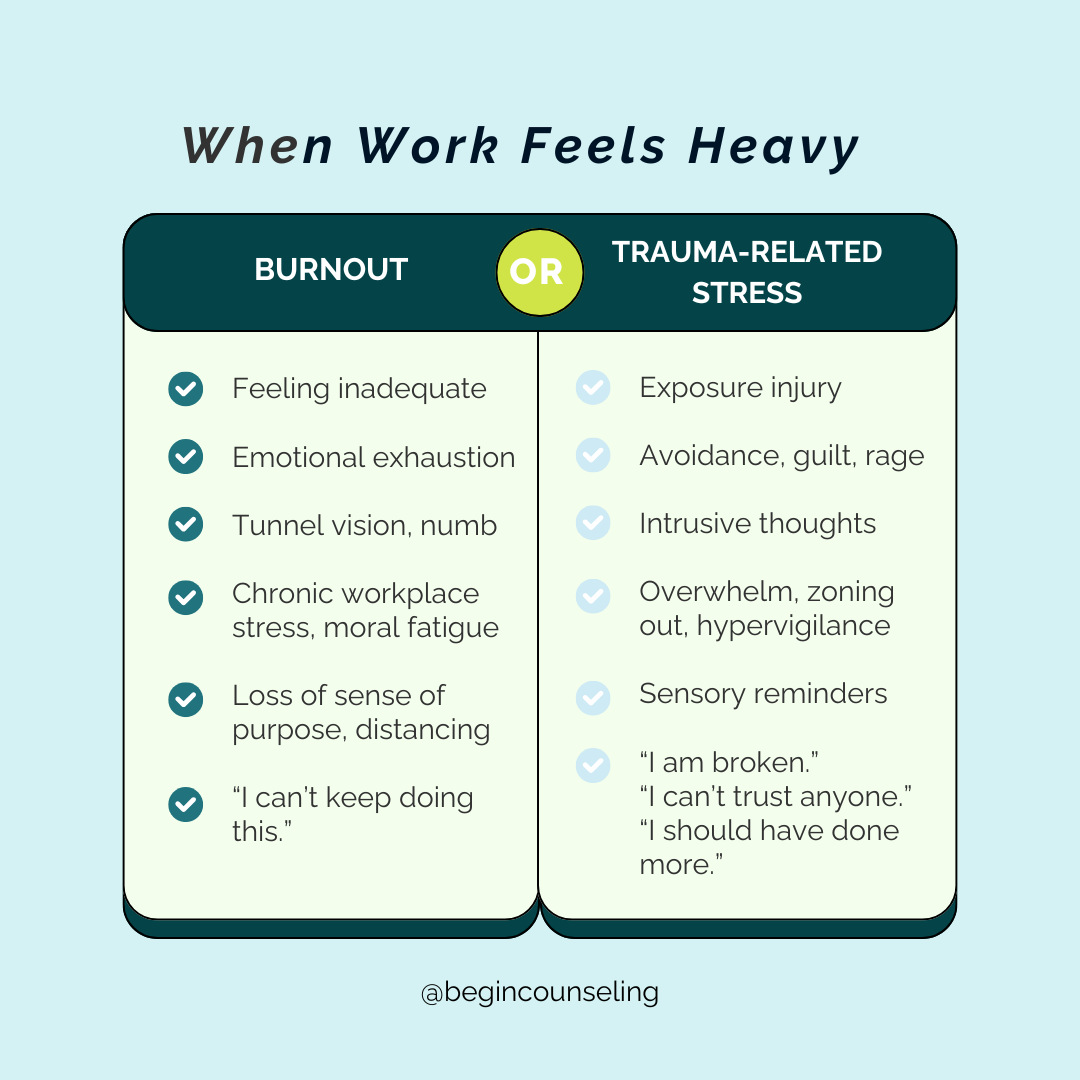
Prolonged workplace stress and moral fatigue can lead to a loss of purpose, withdrawal from coworkers or family, decreased performance, emotional distancing, and thoughts like, "I have nothing left to give" or "I can't keep doing this." You begin to dread the next shift in a profession you once loved. You assume the worst of others. Tunnel vision takes over.
Burnout builds gradually and can erode your sense of accomplishment. It's the slow drain of energy, passion, and connection that happens when demands consistently outpace resources and recovery. We often hear professionals describe feeling like they're going through the motions, that their work no longer holds meaning, or that they've become cynical about the very things that once inspired them to enter their field.
The physical symptoms of burnout mirror those of chronic stress: persistent exhaustion that sleep doesn't fix, headaches, digestive issues, and a weakened immune system. Emotionally, burnout manifests as detachment, irritability, and a sense of ineffectiveness. You may find yourself snapping at loved ones, avoiding social situations, or feeling nothing at all.
It's important to understand that burnout often exists alongside trauma-related stress, making self-attunement essential to well-being. In high-stress professions, trauma and burnout frequently occur together, each compounding the effects of the other.
Get Real About Trauma-Related Stress
Trauma is an exposure injury intersecting with your unique personal being. In our work with first responders, medical professionals, and others in high-stress roles, we recognize that trauma isn't simply about what you experienced, it's about how your mind and body integrated (or did not integrate) that experience.
What gets processed easily and what ends up "stuck" is influenced by a complex system of neural pathways, memory networks, and life experiences. Two people can respond to the same critical incident in completely different ways based on their personal history, support systems, biological stress responses, and previous exposure to traumatic material. Your nervous system is uniquely yours.
Signs of trauma-related stress can include avoidance, intrusive thoughts, overwhelm, restlessness, zoning out, guilt, shame, rage, sensory reminders, and distorted beliefs. You might find yourself avoiding certain locations or aspects of your work. Intrusive images, sounds, or smells from difficult incidents may interrupt your thoughts during quiet moments. You may feel constantly on edge, unable to relax even when you're safe at home.
The wounds of trauma murmur relentlessly: "I am broken," "I can't trust anyone," "I should have done more." These cognitive distortions become the lens through which you interpret your experiences, your relationships, and your worth. In our clinical work, we help professionals identify these patterns and understand that these thoughts, while they feel true, are symptoms of maladaptively stored trauma. They are not facts about who you are.
Trauma-related stress differs from burnout in that it often involves specific triggering events or accumulation of exposures that have overwhelmed your capacity to cope. While burnout says, "I can't do this anymore," trauma says, "I'm not safe" or "Something is fundamentally wrong with me."
The Good News: There Is a Path Forward
You don't have to quit your job, change careers, or give up on your professional purpose. But you do need rest and systemic support. Boundaries with yourself and others, reconnection with who you are, and time in spaces and with people who refresh you can help extinguish the heat of burnout. This isn't about bubble baths and surface-level self-care (though those don't hurt). It's about fundamental changes in how you structure your work life, protect your off-time, and balance your personal and professional identity.
Setting boundaries might mean saying no to extra shifts, turning off your phone on days off, or having honest conversations with supervisors about unsustainable workloads. Reconnection involves remembering who you were before this job consumed you, what brought you joy, what made you laugh, what gave your life meaning beyond your professional role.
Learning to self-regulate, expanding your support system, and seeking professional trauma treatment can help you not just survive until retirement, but truly thrive in the meaningful work you were called to do. Self-regulation skills, breathing techniques, grounding exercises, and mindfulness practices, give you tools to manage your nervous system in real time. A robust support system provides the connection and perspective you need when the work threatens to overwhelm you.
Professional trauma counseling, particularly evidence-based approaches like EMDR (Eye Movement Desensitization and Reprocessing) and other specialized trauma-focused therapy, can help reprocess stuck experiences and rebuild a sense of safety and competence. Focused interventions are designed to help you heal specific wounds so you can return to thriving in your work.
The Value of Specialized Counseling
Truly competent counseling with providers knowledgeable about your career can create steadiness before you need it. Not all therapists understand the unique demands, culture, and stressors of high-stress professions. Working with someone who gets it, who understands shift work, critical incidents, organizational dynamics, and the unspoken codes of your profession makes a profound difference in treatment outcomes.
In our practice, we specialize in working with professionals like you. We understand that asking for help goes against everything your training taught you. We know that vulnerability feels dangerous in cultures that prize toughness. We recognize the real barriers you face: scheduling challenges with shift work, concerns about confidentiality, fear of career consequences, and the simple fact that you've spent your career taking care of others and have little practice receiving care yourself.
Preventive mental health care, seeing a counselor before you're in crisis, allows you to build coping skills, process experiences before they become stuck, and develop awareness of your personal warning signs. It's like physical conditioning: easier to maintain fitness than to recover from injury.
Taking the First Step
Increase your self-awareness. Pay attention to your own red flags. What are your early warning signs that stress is building? Do you stop sleeping well? Isolate from friends? Increase alcohol use? Snap at your partner? Lose interest in hobbies? Everyone's pattern is slightly different, but you likely have one. Learn it.
Your family deserves your presence, not just your physical proximity, but your emotional availability and engagement. The people who love you notice when you're going through the motions, when you're there but not really there. They deserve the whole you, not just what's left after you've given everything to the job. Care isn't just for others; you are worth it too. This might be the hardest truth to internalize for those in helping professions.
You've dedicated your career to others' wellbeing. Now it's time to extend that same compassion to yourself.
Begin to notice.